
Art-Net vs sACN
They’re not two completely different things
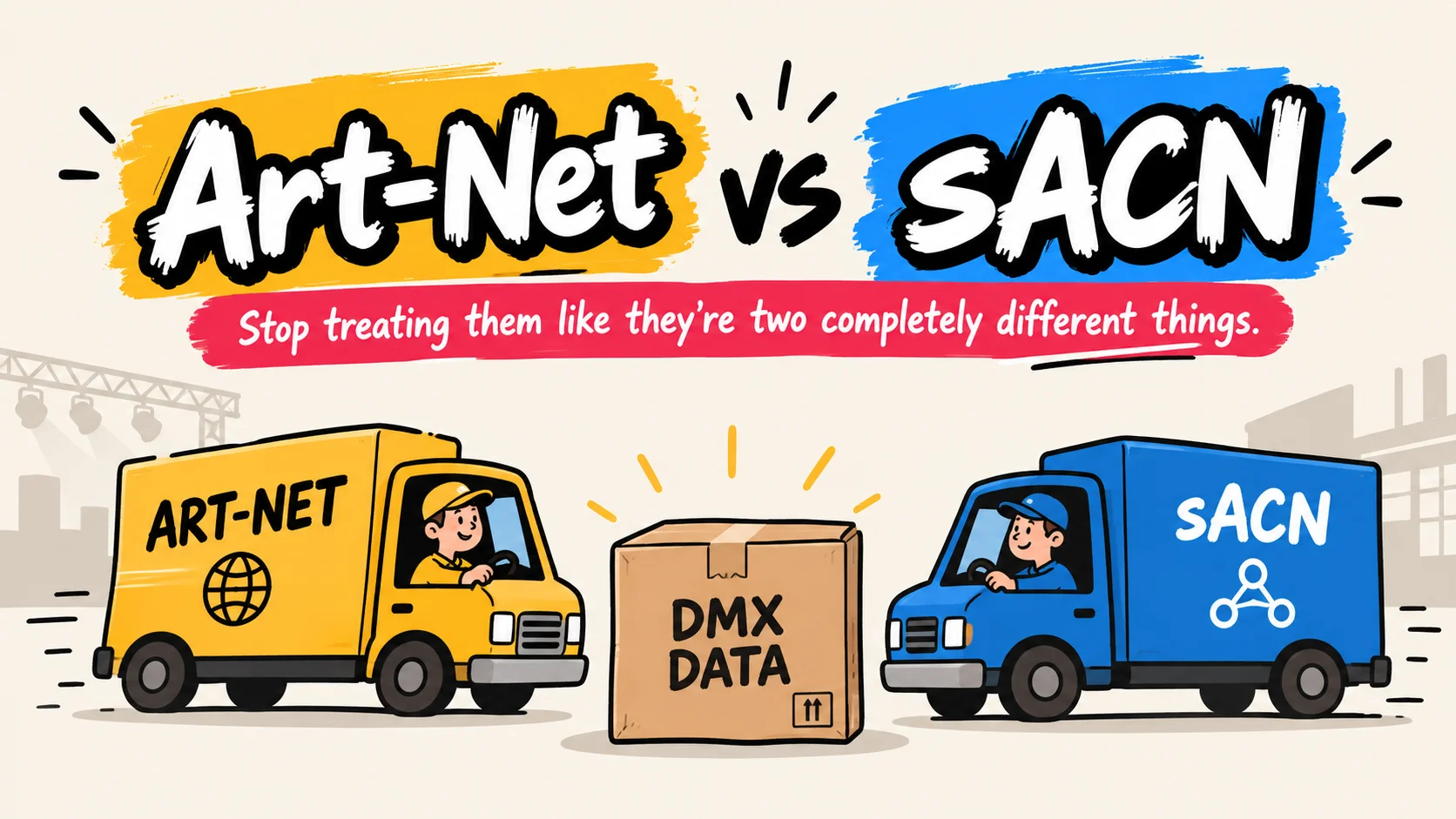
If you’re just getting into lighting networks, it’s very easy to think that Art-Net and sACN are two completely different technologies. Different names. Different options on your console. One person says, “I only use Art-Net.” Another says, “For big shows, you should use sACN.” At some point, it starts sounding less like networking and more like choosing a football team. But the reality is much simpler:
Art-Net and sACN basically do the same job: they transport lighting control data over an Ethernet network.
The main difference is how they transport that data. And probably the easiest way to understand it is to imagine that you’re shipping a package.
📦 DMX is a package
Think of DMX data as a package. Inside that package is information like:
- Fixture 1: Dimmer 100%
- Fixture 2: Red 255
- Fixture 3: Pan a little to the left
- Fixture 4: Do absolutely nothing, Stay right there.
Normally, DMX512 sends this information directly over a DMX cable. But as lighting systems get bigger, we often want to move those “DMX packages” across an Ethernet network instead.
That’s where Art-Net and sACN come in.
Think of it like this:
- Art-Net = one shipping company.
- sACN = another shipping company.
They can both carry essentially the same lighting control information. They can both move that information from your console, across the network, to a node. And at the other end, the node takes that network data and turns it back into physical DMX for your fixtures. So Art-Net and sACN are not two completely different types of DMX. They’re more like two different delivery services carrying the same package.
🚚 Art-Net - the delivery guy who’s been around forever
Art-Net is one of the original lighting-over-network protocols, and it has become incredibly common in live events. One of its biggest advantages is simple: A lot of equipment supports it.
Lighting console? Yep.
DMX node? Yep.
Media server? Probably.
Pixel controller? Very likely.
That mysterious black box that has been sitting in the bottom of the flight case since 2012? …there’s a decent chance it speaks Art-Net too. And that’s exactly why Art-Net is still so useful. It’s widely supported, relatively straightforward to configure, and especially convenient when you’re working with a mixed system containing equipment from different manufacturers and different generations.
If your setup consists of:
A new lighting console,
A couple of older nodes,
A media server,
Some pixel controllers,
And one rack nobody wants to touch because “it works, so please don’t touch it”…
there’s a pretty good chance you’ll run into Art-Net somewhere. Art-Net is basically the delivery guy who has been doing the job for 20 years. Maybe not always the newest solution. But he knows every street in town.
📬 sACN - the delivery service built for a much bigger city
sACN, or Streaming ACN / ANSI E1.31, is a standard designed specifically for transporting entertainment lighting control data over IP networks. It came after Art-Net and was designed with modern, large-scale lighting systems in mind. That starts to matter when your system goes from:
“I have four universes.”
to:
“I have 400 universes.”
Now things like network traffic, data distribution, priorities, redundancy, and how devices participate in the network start becoming much more important. This is where sACN really starts to make sense. That’s why you’ll often see it in large venues, permanent installations, theme parks, broadcast facilities, and productions involving hundreds of universes. Not because Art-Net suddenly becomes “bad.” It’s just that when the city gets bigger, you start caring a lot more about how the delivery company delivers the packages.
🏘️ Broadcast vs Multicast - or the story of a delivery guy yelling in the street
This is probably my favorite way to explain the difference. Imagine that each Universe is a neighborhood. Inside that neighborhood are lots of houses – the devices connected to your network. One traditional way you’ll often see Art-Net distributed is through broadcast. The delivery guy arrives at the entrance to the neighborhood and screams:
“ANYBODY HERE ORDER ART-NET UNIVERSE 1?!”
The intended receiver hears him.
But…
The house next door hears him.
The house across the street hears him.
The guy watering his plants hears him.
The dog at the end of the street hears him.
And the network switch is basically standing there going:
“Okay, okay… I’ll tell everyone.”
For a small system, this usually isn’t a big deal. But when you have lots of universes, lots of senders, and lots of devices sharing the same network, you might not want everyone listening to everything.
🏠 So what does sACN do differently?
sACN commonly uses multicast. A simple way to imagine multicast is that every Universe has its own delivery group. If a device needs Universe 27, it joins the group for Universe 27. The network can then deliver Universe 27 data to the devices that actually asked for it. Devices that don’t care about Universe 27? They don’t need it. No package for you? No need to come outside. No need for everyone in the neighborhood to hear the delivery guy screaming anymore. And when your lighting network becomes very large, that can make data distribution much more manageable.
“Technical footnote before the network engineers show up at my house:
This analogy is intentionally simplified. Art-Net can also use unicast, and sACN also supports unicast. The important point is that multicast is a fundamental and very natural part of how sACN distributes universe data.”
So don’t memorize this as:
Art-Net = broadcast. sACN = unicast.
That’s not quite right. Instead, remember that both protocols are transporting lighting data across a network, but they provide different ways of organizing and distributing that data.
⚔️ So… which one is better? Art-Net or sACN
Simple answer:
Neither.
A better question is:
“Which one makes sense for this system?”
Working on a small setup with a handful of universes, mixed equipment from different manufacturers, and you just need everything talking quickly? Art-Net can make perfect sense. Building a large lighting network with hundreds of universes where you want a more structured and scalable approach to distributing data? sACN can make perfect sense. Already have a console, nodes, and infrastructure running perfectly well on Art-Net? There’s probably no reason to wake up on Monday morning and decide:
“You know what would make my week more exciting? Converting the entire system to sACN.”
Please don’t. Both Art-Net and sACN are excellent choices. There isn’t really a universal “best protocol.” It depends on the system you’re working with.
🧠 If you don’t want to remember everything above…
That’s completely fine. You really only need to remember four things:
- DMX = the lighting control DATA.
- Art-Net / sACN = ways of transporting that data over an Ethernet network.
- Node = takes that network data and converts it back into physical DMX.
- And finally: The fixture doesn’t care how the DMX got there.
Your moving head isn’t sitting there thinking: “Hmm… this signal arrived via sACN today. Very professional.” It only cares about one thing: What are my DMX values? And that’s probably the simplest way to think about Art-Net and sACN: Same package. Different shipping companies. Don’t turn it into a war. We’re just trying to make the lights turn on. 💡